
Spring is a time of awakening, and every spring I am awed by the power of one tiny little seed. Seed is the source of life. Seeds create, recreate, regenerate, and multiply themselves. We plant it in soil, tend it, and watch as it grows into something magical! A plant that produces gorgeous blossoms in a myriad of colors for butterflies, bees, and me, or after blooming gives us magnificent tomatoes, squash, beans, and other delicious food for our table and pantry. I always feel that it is pure magic! Throughout history, people have saved and collected seeds, passing them down through generations. These heritage seeds are strong, resilient, and resistant to pests and climate change. The old ones understood seeds.
In the 1970s, we understood that not all seeds were created equal. With the advancement of hybrid and GMO seeds, we face corporate control, long-term health risks, and a loss of biodiversity. Hybrid seeds result from natural crosses, while scientists genetically create and engineer GMO seeds in a lab using transgenic technology. The result is a pesticide-resistant seed requiring higher chemical use and potential damage to native species. Corporations hold patents on their seeds and restrict seed saving, forcing farmers to purchase new seeds every year.
Interesting fact: Seed saving has been taking place for thousands of years. In fact, seeds used to be distributed by the U.S. Postal Service, free of charge, to farmers to grow and adapt to different climates. They specifically selected and distributed seeds based on their performance in the local climate, which encouraged diversity. However, in 1924, the American Seed Trade Association saw the potential for growth and convinced the federal government to discontinue the free seed distribution program.
Heritage seeds are open pollinated which allows the seeds to be harvested, saved, and replanted, producing a true to type plant and fostering self-sufficiency. Heirloom varieties carry cultural stories and preserve sustainable traditional farming practices, often linking to family, regional, or Indigenous histories. Melissa Nelson, a professor of Indigenous sustainability at Arizona State University, says, “Heirloom seeds are deeply tied to cultural heritage.” Long before the supermarket existed, these cultivars were key to how we ate: “They produce seeds naturally that you can save and grow again for the next generation, and also share with friends and family…You knew that your ancestors relied on them, so you want to keep them going.”
Food sovereignty, driven by heirloom seeds, gives people the power to choose their food and manage its growing process and origin. “For generations, heirlooms have saved communities from food scarcity,” says Ashleigh Smith, managing editor at the seed company True Leaf Market. This is a complex topic, and I have only touched on it. There is much more information out there for the harvesting…and it is important to know where our food comes from and how to provide for future generations.
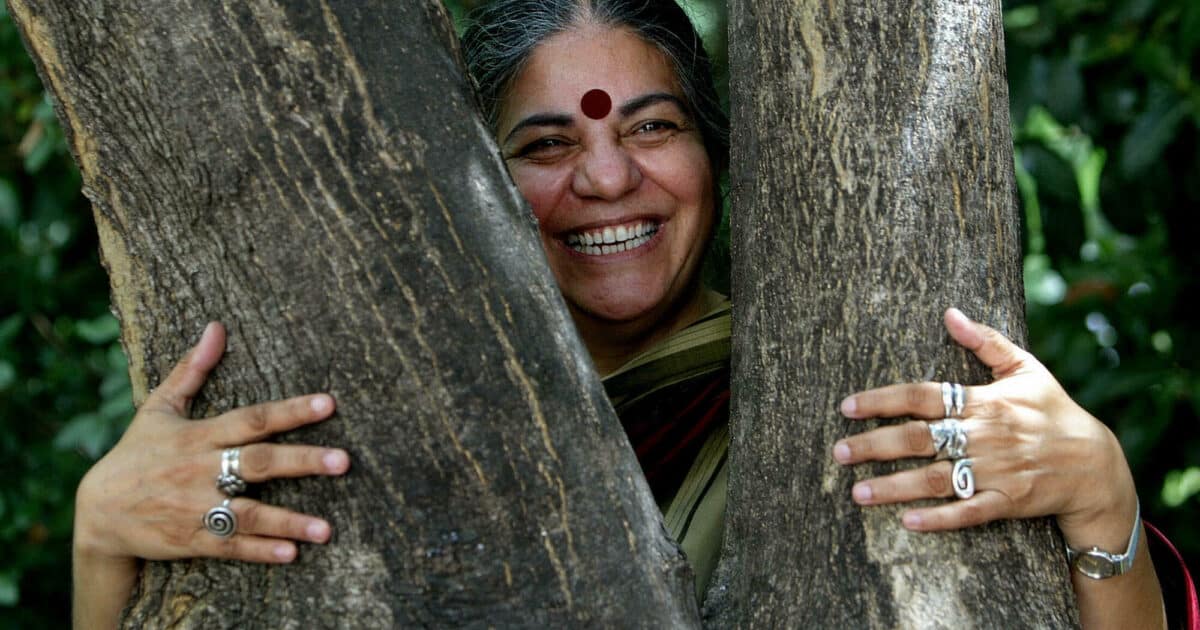
I’m preparing heritage seeds for the fifteenth year for the seed library at the Mancos Library; it almost feels like a spiritual practice! I think of the magic of seeds and the importance of their preservation. One woman comes to mind as I drop seeds into envelopes and label them. That woman is Vandana Shiva.
“A seed sown in the soil makes us one with the earth. It makes us realize we are the earth.”
Vandana Shiva was born on November 5th 1952, in Dehradun, in the foothills of the Himalayas, in India. Her father was a conservator of forests, and her mother was a farmer. Both her parents loved and respected nature. Vandana’s early education was in convent schools in her hometown. In 1972 she earned a BS in physics at Panjab University in Chandigarh. She worked briefly at the Bhabaha Atomic Research Center before relocating to Canada to earn an MA in the philosophy of science at the University of Guelph in 1977. The following year, Vandana earned a PhD in Philosophy at the University of Western Ontario. As an activist, Vandal has written and lectured extensively about food and agriculture. She has educated and campaigned for intellectual property rights, biotechnology, bioethics, and genetic engineering. Her heart was in grassroots organizing and worked to support the Green movement in Africa, Asia, Latin America, Ireland, Switzerland, and Austria, strenuously opposing agricultural growth and advances through genetic engineering.
For several decades, Vandana worked tirelessly with various institutions, some of which she created, against the destruction of natural biodiversity. Her report in 1990, “Most Farmers in India are Women”, highlighted that men migrate or hold family titles, women manage most of the agricultural work, from sowing to harvesting. They are the backbone of Indian agriculture and are responsible for biodiversity conservation, seed saving, and food security, but are largely invisible in official government reporting. Shiva knows women are not just laborers but custodians of agricultural knowledge, particularly in conserving seed diversity. She has written over twenty books, and her awards and accolades are innumerable.
Vandana’s life’s work is educating and supporting the idea of seed freedom and the rejection of new plant lines or cultivars. She has won battles with corporations over the patenting of life (seeds) and called it “biopiracy.” She advocates against the prevalent “patriarchal logic of exclusion” she claims that a woman-focused system would be a great advancement and that the ecological destruction and industrial catastrophes that threaten the quality of all life have become women’s responsibility to conquer.
Vandana is a scholar, activist, and anti-globalization author. She is a driving force and board member of the International Forum on Globalization. She has been the target of critics and often challenged. When she sued Monsanto in 1999 for its illegal cotton trials in India, after which she received death threats. Oxfam received a letter from her saying that she sincerely hoped it wasn’t planning on sending genetically modified to feed starving people. She has endured barrages of public relations assaults. Often major news outlets have not been kind to her.
From what I can determine, Vandana Shiva is certainly a controversial figure, but one whose focus is on saving our food supply. Her ability to call out the patriarchy, challenge corporations, and speak truth to power is inspiring. She is a visionary who fights for biodiversity, indigenous wisdom, and the rights of Mother Earth. Her activism in the anti-GMO movement has earned her the nickname “Gandhi of grain.”