
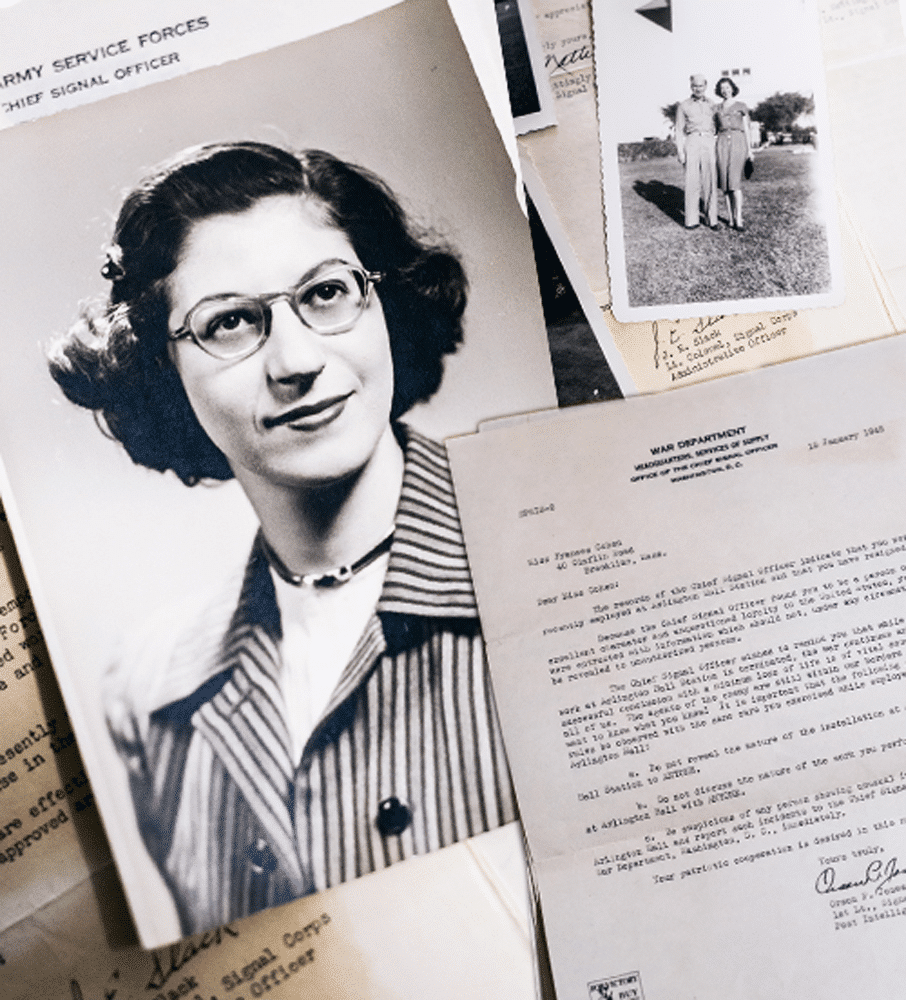
“One of my great aspirations is to know that I’ve left a legacy, as best I could, of peace.”
Remembering a heroine of our times. Fran passed away last evening at home on the ranch, surrounded by loving friends, family, and music. You will be remembered Fran. Thank you for all you did.
This narrative is a combination of my conversations with Fran over several years and an interview with her by Bostonia, the publication of her alma mater, Boston University, back in 2019, and excerpted from They Roared.

Fran Pearlmutter was born in June 1923 and grew up in Brookline, Massachusetts. Her mother was a seamstress and her father manufactured top-of-the-line men’s overcoats. During the war, Fran’s father donated jackets to soldiers and sailors. “I was very fortunate in that I was born to a mother and father who really loved me,” she said. “And they never failed to show me daily that they loved me. And more than that, they loved each other.”
Fran is a beautiful woman who, at over 100, dresses very fashionably, has her hair done regularly, her nails are painted the latest colors, and she proudly wears a Veteran’s cap. Fran is a tiny woman, but her heart and spirit are enormous! She is always off on some adventure or another. Fran is a thinker, often pausing to analyze things. She is extremely well-spoken with a clear, slow voice, and careful enunciation. She loves libraries, her family, especially her greatgrandchildren, reading, and life!
Fran remembers that she really had a passion for linguistics. This drew her to Boston University at a time in history when only 3.8 percent of American women were enrolled in any kind of higher education. After graduating in 1944, it didn’t take the Army long to identify her as someone that could help the war effort. They recruited her as a “cryptanalytic aid” in their code-breaking division, the Signal Intelligence Service (SIS) which provides timely and accurate cryptologic support, knowledge, and assistance to the military cryptologic community while promoting partnership between the Armed Forces Security Agency, which later became the National Security Agency (NSA), and the cryptologic elements of the Armed Forces. Fran recalls that after the attack on Pearl Harbor and the United States entered WWII, the U.S.
The Navy sent letters to about10,000 well-educated women asking two simple questions: “Are you engaged to be married?” “Do you like puzzles?” Presumably, the government obtained vital information about these women from the colleges or universities they attended. Those who answered no and yes respectively to the above questions, were recruited immediately as “code girls,” to intercept and decrypt messages coming over the airwaves from Japan. These women were critical personnel during World War II.
The Army sent Fran a train ticket to Washington, D.C., and upon her arrival, she was picked up at the station in an official military car and driven the six miles to Arlington Hall Junior College for Women. The government had commandeered it as their headquarters. It was all very cloak and dagger. Barbed-wire fences, barracks, and makeshift offices were everywhere. This college campus had become home to 10,000 code breakers. More than half of them were women. Under the threat of treason, they were all ordered to keep their work secret. If the women were asked what their occupation was at Arlington Hall, they were told to respond that they sharpened pencils.
They all knew that the order of silence was to be taken very seriously. Fran’s parents understood she was doing covert work, though they didn’t know exactly what. They did know she wasn’t sharpening pencils. Whenever anyone asked, and they did frequently, what had become of Fran, her parents feigned complete ignorance. This must have been difficult because they were very proud of their only daughter who was involved in the war effort. But they did as they were instructed.
At Arlington Hall, they took Fran into a small room. “I was told I must learn Japanese. I stayed up until maybe midnight, and then seven hours later, I was doing the same thing.” Fran was soon interpreting messages written in Japanese, encrypted, and transmitted as a series of dots and dashes representing syllables and punctuations. She says the film The Imitation Game, produced in 2014, glamorized code-breaking. In reality, it is quite tedious work involving statistical analysis and searching for patterns in those dots and dashes, using a grid to translate them back into Japanese and then into English. It was a time-consuming pursuit and sometimes very frustrating. Not at all glamorous according to Fran. She talks about the difficulty of this type of cryptology: “Translating from one language to another—for instance, French into Spanish or French into English—that I can do. There’s a commonality among languages. You know one, you can learn from another. However, when you’re working with Japanese on a large board balanced on a table or on your lap — that was not easy. I learned to use the grid and when the dip dip dips came over the airwaves, I was able to help crack the code.”
Each day the code girls determined the location of the Japanese army on the Pacific Islands and put together an “order of battle” that outlined their proposed strategies. This information went straight to the Pentagon where it was critical in the Allied defeat of Japan. The work of these dedicated women (and men) helped to bring the war to an end. It was their advancements in code-breaking that helped establish the National Security Agency (NSA). Those increased strategies for safeguarding data laid the groundwork for modern cybersecurity.
Not all their time was spent nose to the grindstone, or grid. Most maybe, but Fran talks about taking long, leisurely walks on Sundays with a friend to clear her head and loosen up her body from the intensity of their work. There was a lovely cemetery close to their Arlington barracks where they enjoyed picnicking and walking. One Sunday they were lounging on the grass, talking, and they let time get away from them. What they did not realize was the cemetery had iron gates that were locked each day at dusk and not opened until the following morning. It also had very high walls surrounding it. It was just after dusk. They were locked in! Fran said they considered their plight for a while, but then just scrambled up the wall and got back to their rooms. It seemed the only egress available to them. They were a bit bedraggled, stockings in tatters, and a few scrapes, but at least they didn’t have to spend the night in the cemetery.
When Fran was asked by an interviewer if she had a particular heroine, she replied almost instantly, Eleanor Roosevelt. When she was a Girl Scout, Fran met Eleanor Roosevelt who made a lifelong impression on her. Her Girl Scout troop took first place in cookie sales one year, winning them a trip to Washington, D.C. The girls were each picked up and driven in a big, fancy limousine. Eleanor greeted them at the door and had tea with them. Fran was very impressed and remembered Mrs. Roosevelt as a very classy, sincere, and warm woman. “She was gracious,” Fran said. “That’s one word I would use for her.”
When the war ended in 1945, all the code girls were simply sent home without fanfare and with little recognition. Fran has often told me she didn’t do the work for recognition. She never wanted it or expected it. Fran worked for her country, not the glory. Liza Mundy who wrote an article on women cryptographers for Politico, says they “came from a generation when women did not expect to receive credit for achievement in public life.” In her book Code Girls, Liza exposes the work those women did long ago and long forgotten. She says, “They did not make up the top brass, and they did not write the histories afterward, nor the first-person memoirs. It completely hid their efforts for over 70 years, their contributions mentioned only in passing.”
When Fran told me she never, ever, spoke of her work, even to her husband, this surprised me. Certainly, at the time it was critical to keep their work secret, but so many years later? Her children grew up thinking their father was the only war hero. He was a lieutenant colonel with Bronze and Silver Stars, a Purple Heart, and a key to the city of Feltre, Italy, where he served as a provisional governor at the end of the war. His were the stories that were told, and his were the stories that Fran’s daughter, Debby, heard growing up.
Fran says she thought little about the past. She enjoyed traveling, and she traveled the world, working as a travel agent, cruising down the Nile, rafting in Canada, and taking tour groups to the Far East, Turkey, Greece, Romania, and what was then the Soviet Union. Fran gets a faraway dreamy look in her eyes when she talks about her travels. Those trips were the highlight of her life. Her daughter Debby says, “She was nonstop traveling. I mean, nonstop, for several years. There aren’t many places in the world she hasn’t been.” Fran smiled and said, “I enjoyed taking people out on trips to show them the breadth and scope of our nation.”
Fran often tells her daughters about a memorable trip to Alaska during the 1986 Iditarod Trail Sled Dog Race. She relates how she watched American musher Susan Butcher become the second woman to win the Iditarod: “She was holding the reins of these huge, wonderfully strong animals. When she came by, it was unbelievable; her legs were the size across of five women.” Susan became the second woman to win the Iditarod. Libby Riddles was the first in 1985. Much later when Fran wasn’t traveling as often, she took the time to reflect on her life. It was then she realized all she had accomplished. She joined the Jewish Veteran’s group and shared some of her wartime experiences with her family. Debby says stories still come out in bits and pieces. Her children are proud of her and have expressed gratitude that she served her country. Fran always told her daughters, “There’s no restrictions on what you can be or do. Be whatever you want to be as a woman.” Wise words.
Note: A quick refresher on history and why these women code breakers were so critical to the war effort. When Adolf Hitler invaded Poland, WWII began. This conflict spread around the world. The Axis powers were Germany, Italy, and Japan. The Allies were Britain, France, Russia, and China. With the bombing of Pearl Harbor on December 7, 1941, the United States, which had previously been neutral, entered the war. Tensions were running high, and many countries had developed “codes” containing secret, disguised, war strategies and/or names of people, places, and battle plans. The “code breakers” looked for patterns, using complex mathematical skills and developing technology to assist them. Long strings of letters and numbers that looked like nonsense were studied and it was never easy. The women took shifts and worked around the clock. They knew their work was essential and they took it very seriously. One woman code breaker Ann White said, “Everyone we knew and loved was in this war.”
The women cipher experts even tested American codes to ensure that the enemies could not break them. Women code breakers were doing the exact same work as the men, sometimes better because of their attention to detail, but were paid less than their male counterparts. Often, they were treated with disrespect and assigned to “housekeeping” tasks, like washing windows.
Men often took credit for the accomplishments of women and that is no secret! For example, J. Edgar Hoover, the first director of the Federal Bureau of Investigation, said that he and his group broke up a Nazi spy ring in South America. Untrue!! It was Elizebeth Smith Friedman, America’s first code breaker, who actually uncovered this spy ring.