
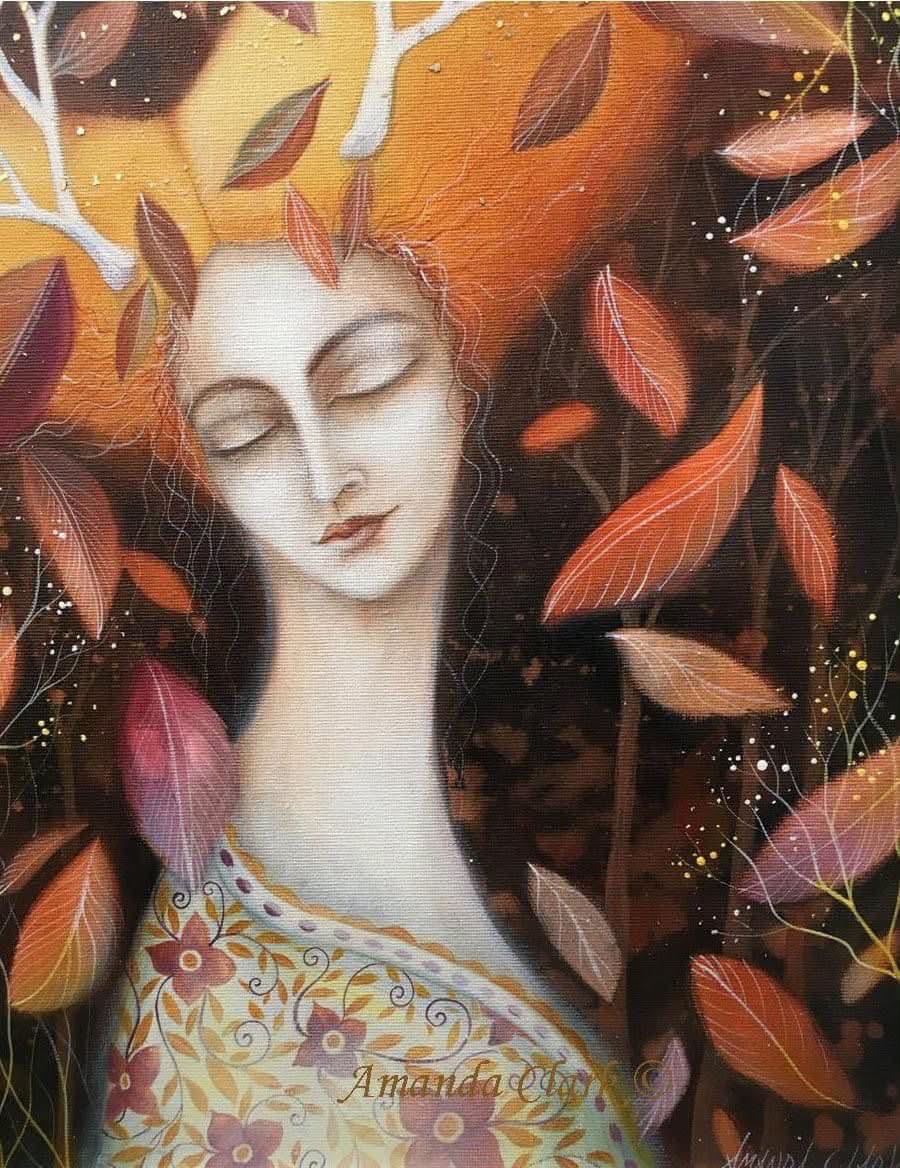
Witches have always fascinated me, but I always saw beyond the type of witch portrayed in The Wizard of Oz. The witches I embraced were kind, gentle, and knowing. Throughout history, society has grossly misunderstood, persecuted, and burned witches at the stake.
We are in the season of Samhain, which is celebrated between the evening of October 31st and November 1st. It is a time when the veil between the physical and spiritual world thins, a time to honor ancestors, and a time of reflective magic. Not magic in the way those wonderful witches practice in the film Practical Magic (although I do love that film) but in a truly deep and spiritual way.
According to traditional Irish folklore, Samhain is the start of the new year, and people would prepare for the cold winter ahead. People hunted, harvested, and stored food. Druids and Priestesses guided the people in spiritual matters and this important autumnal celebration. The belief that many still hold today is that during this time, the veil between worlds thinned and spirits of the dead could return to the land of the living. People conducted ceremonies to pay respect to the dead and confirmed that their legacies remained important. People carved turnips and placed lights inside to use as lanterns in doorways and windows. Pumpkins came much later in other parts of Europe.
So you may ask, how do witches end up at Samhain? As already noted long before the caricature of the wicked witch, wise women herbalists, folk medicine practitioners, midwives, and healers existed. I the Celtic tradition, figures like Volva or divine hags like Cailleach and Morrigan have great healing power and respected roles in the community.
As Christian missionaries invaded these territories and replaced honored Celtic festivals with All Saints’ and All Souls’ Day, the ancient practices were reshaped and reinterpreted as demonic and heretical. This is where the church transformed folk healers and pagan customs into the evil of the satanic witch.
We all know about the Salem Witch trials, but the court actually found a few of the accused not guilty, allowing them to escape death.
In 1657, authorities charged Elizabeth Garlick (Goody Garlick) of East Hampton, New York, with “consorting with the devil, thereby causing illness that caused the death of children and livestock. Governor John Winthrop, Jr., who found her completely innocent of all charges tried Goody’s case in Hartford, Connecticut,. She returned home, living a quiet life with her husband until she was almost 100 years old.
Another notable witch survived accusations through legal trials only to be victims of vigilante violence. Mary Webster was one such woman. She was born in England sometime between 1617 and 1624. She sailed to New England, where she resided in the small Puritan town of Hadley, Massachusetts.
At fifty-three, officials accused her and took her to a jury trial in Boston for suspicion of witchcraft, yet the jury found her not guilty of all charges. A year later, Philip Smith, who was a judge, a deacon, and a representative of the little town of Hadley, accused Mary of witchcraft. He was an unsavory fellow and a hypochondriac. He thought that witchcraft caused his illnesses. Phillip ordered a few young men to drag Mary out of her home and hang her until she was nearly dead.Then, they cut her down and buried her in the snow, believing she was dead. However, Mary survived to live a long live and Phillip Smith died in shame.
Samhain is not just about honoring the dead but also about confronting our own shadows. As days grow shorter and the earth descends into darkness, we can use this time to reflect on personal growth and releasing what no longer serves us. It is a time of new beginnings and setting intentions. This time connects ancient Celtic traditions to modern Wiccan beliefs, creating a gorgeous tapestry of ritual and celebration that transcends time. However you celebrate (bonfire, altar, just reflecting on the year that has gone by) this is the season that invites us to embrace the cycles of life, death, and rebirth.
“Look you at the kettle-hook hanging low to the flames. See how it is changed. See how it glows when it is touched by fire. Iron is an ancient and magic metal. There is iron in our blood, and love is like fire. Look at the kettle-hook. See it; and when it hangs cold and black over an empty hearth and longing is in your heart, remember it as we see it now together. Remember, there can be no radiance without love, and no longing where love has not been.” (Excerpt from the Rising of the War by Ann Moray)
Let the memories sustain us through this time of cold, short days, and darkness. Whatever we release, let’s remember to keep the radiance of love shining bright, and alive.
Art by Amanda Clark at earthangelsats


