
“These are the times that try men’s souls…” I will add that they try women’s souls as well. That is an opening phrase from The Crisis, by Thomas Paine, written on December 23rd, 1776. He goes on to say, “‘Tis surprising to see how rapidly a panic will sometimes run through a country.” He might as well have written that yesterday, because here we are! Each of us has his or her own way of coping, of resisting, and of maintaining a semblance of sanity.
A dear friend recently suggested a book that she said was keeping her sane, Fear Less Poetry in Perilous times by Tracy K. Smith.
I love some poetry; Mary Oliver speaks directly to me, straight into my heart. Poets like Robert Frost and Robert Louis Stevenson, A. A. Milne, Kenn Nesbitt, Eugene Field,(The Gingham Dog and the Calico Cat), and Louis Carroll all delighted me as a child. There was a connection for me through poetry, and I especially loved “The Children’s Hour” by Henry Wadsworth Longfellow. When my children were growing up, they enjoyed much of the same poetry, and as they got older, they particularly enjoyed Shel Silverstein, Jack Prelutsky, Dr. Seuss, and Roald Dahl. They particularly loved the Silverstein poem Clarence…a boy who orders “a brand new Maw, a better Paw” to replace his old parents, who he sells at a garage sale.
While I loved poetry as a child, as I grew into adulthood, aside from my collection of treasured children’s poems, I never felt that I really “got” poetry. I wrote some as my personal form of expression and to work through difficult things, but never felt I was doing it “right.” You can imagine that reading Smith’s words, “There is no formula for reading poetry. How could there be when the lyric tradition exists in celebration of the individual self and its singular experiences of the world” I began to look at poetry with new eyes and a desire to understand it more fully.
There is a fabulous article in Marginalia by Clark, where she points to a question asked by the Proust Questionnaire of David Bowie… “What do you regard as the lowest depth of misery? (The Proust Questionnaire is a set of questions answered by the French write Marcel Proust and often used in modern interviews) Bowie answered, “living in fear.”
Clark writes in the Marginalia article:
“The most menacing word… fear, really is something we live inside, not with — a cage, a tomb, a small dark room that comes to eclipse the world as the hand quivers outside the pocket in which the key is kept. The best key I know to the prison of fear is curiosity, and the most generous form of curiosity I know is poetry…it is an inquiry, an invocation, an invitation, poetry opens a side door to consciousness, bypassing our habitual barricades of thought and feeling allowing us to enter into the unknowns of what it is like to be someone other than ourselves.”
From the opening of the book, Fear Less…
“When I am lost or afraid, the speakers of poems assure me that my feelings are nothing to hide from or deny – indeed, that vulnerability, uncertainty and even desperation are not only signs of life, but tools for moving forward toward course, hope, and purpose.”
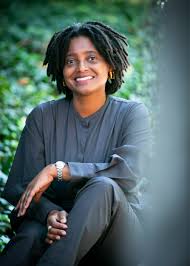
Of course, I bought the book and am hooked! wanted to know more about the author. The book jacket tells me she is the winner of the Pulitzer Prize and the 22nd U.S. Poet Laureate. But wait, there is more…
Tracy K. Smith was born on April 16, 1972, in Falmouth, Massachusetts, but grew up in Fairfield, California. Her mother was a teacher and her father was an engineer who worked on the Hubble Space Telescope. The family placed great value on education, and her interest in writing and poetry developed at a young age. Tracy loved Emily Dickinson, saying that her poems were like “magic” and she committed many of her verses to memory, making them her own. By the fifth grade, Tracy was writing her own poems, and her teacher recognized her talent and encouraged her.
Tracy earned her BA in English, American literature, and African American studies from Harvard University in 1994. While attending Harvard, she joined the Dark Room Collective, an influential African American poetry collective. Established in 1988, the collective hosted a reading series that featured leading figures in Black literature. In 1997, Tracy earned an M.F.A. in Creative Writing from Columbia University, and from 1997 until 1999 she was a Stegner Fellow in poetry at Stanford University. In 2006, she joined the faculty of Princeton University, where she was a member of Phi Beta Kappa.
Tracy has taught at Medgar Evers College of the City University of New York, the University of Pittsburgh, and Columbia University. She taught interim summer sessions at the Bread Loaf School of English at Middlebury College for several summers, and in 2014 was the Robert Frost Chair of Literature and received a Rona Jaffe Writers Award and a Whiting Award. In 2016 she won the Robert Cruelly Award and Columbia University’s Medal for Excellence.
From 2018 to 2020, she hosted the podcast and radio program The Slowdown, a radio show and podcast about poetry produced in collaboration between American Public Media, the Poetry Foundation, and the Library of Congress. She became chair of Princeton’s Lewis Center for the Arts in 2019, and in 2021 Tracy joined the faculty of English and African American Studies at Harvard and was the Wallace Professor at Harvard and Radcliffe Institute and in 2025 was based Boylston Professor of Rhetoric and Oratory. In 2023, the American Philosophical Society welcomed Tracy.
Highly acclaimed as a Pulitzer Prize-winning poet, memoirist, editor, translator and opera librettist Tracy spearheaded American Conversations: Celebrating Poems in Rural Communities with the Library of Congress, and edited the anthology American Journal: Fifty Poems for Our Time, and continues her work as professor of English and African and African American Studies at Harvard University.
From an article in the Harvard Gazette: “I also wanted to test out my own theory that Americans of all backgrounds might have something quietly urgent and humanizing to offer one another, if only we could turn town the volume on all the many sources seeking to sell us on the notion an unbendable divide – to hook us on a product, which is strife. In order to get to community, we have to go quiet, slow down, allow ourselves to be both vulnerable and brave, and approach one another with an idea as simple as I’m me, you are you, we are not the same and yet maybe we can feel safe together talking about something as simple as a poem which encourages the notion that your life must be as important to you as mine is to me. If we let them, poems also encourage the more difficult notion that your life ought to be as important to me as my own life is; that I can truly honor and protect myself by honoring and protecting you.”
One of her students responded: “I get it! When you read a poem, you’re just kind of pouring it through your own filter to see what gets caught there. My filter is different from your filter. And different things will get caught in your filter at different times, depending on who and where you are at the time.” I think he nailed it!
Clearly, Track K. Smith shines a beacon in a world that needs light! Read her; let her inspire you – for she will, and remember her.