
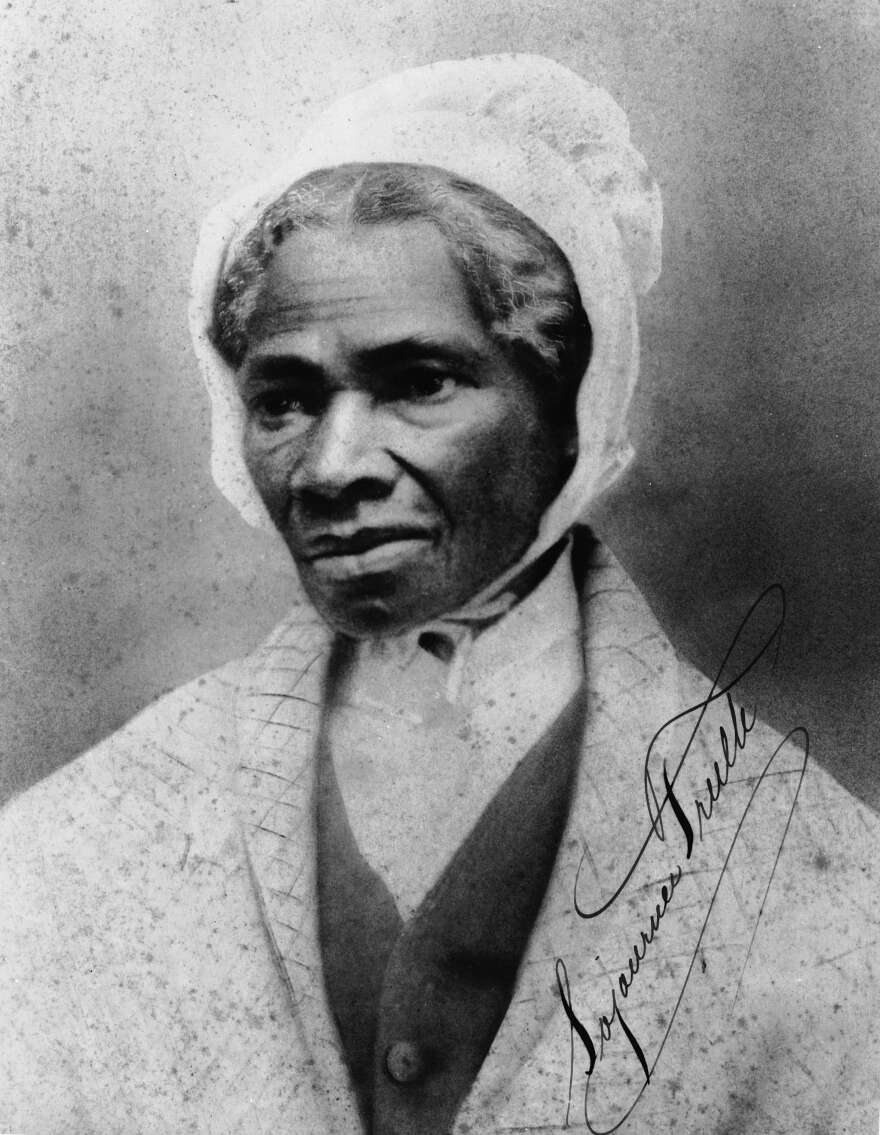
I remember the day, back in the mid-eighties, when I stood at a wooden podium in the Athenaeum in Nantucket, Massachusetts. It was on the second floor, up a winding wooden staircase, int a dusty old room with a scuffed wooden floor and a large window overlooking the Atlantic. People used it as a gathering space for over a hundred years. They told me that both Stephen Douglas and Sojourner Truth made their way up that steep, old, narrow staircase and stood at that podium, their hands on that worn wood. I reverently placed my hands on that wood. It was electrifying.
Isabella Bomfree (Belle) estimates that she was born into slavery sometime between 1797 and 1800, in Esopus, New York, a Dutch area, so she spoke only Dutch and never learned to read or write. She was one of ten or twelve children born to James and Elizabeth Bomefree (“Mau-Mau Bet”). James was a slave captured from what is now Ghana, and was called Bomfree because of his height. In Dutch, boom meant tree. Her mother was the daughter of slaves captured from the area of Guinea. Colonel Hardenbergh bought them from slave traders and kept them at his family estate, Swartekill, in the town of what is now Rifton, about ninety-five miles from New York City. At five, Belle worked alongside her mother, learning all the domestic skills that would make her a valuable slave when grown. Many of her siblings’ sale away from the family when she was young traumatized her for the rest of her life.
Charles Hardenbergh died in 1806; his son, Johannes, inherited the estate. An auctioneer sold nine-year-old Belle and a flock of sheep for $100. John Neely, a very prosperous farmer, bought her for his estate near Kingston, New York. Belle described him as cruel, and he beat her daily. Until now she had only spoken Dutch, but the Neely estate forced her to speak English and mocked her for her first language. She learned quickly but spoke it with an accent for the rest of her life. When Belle’s father visited her at her new home, he was horrified by her injuries. He made immediate arrangements for her to be bought by a Dutch innkeeper and fisherman, Martinus Schryver, in Port Ewen, New York. Because of financial difficulties, after only eighteen months, because of financial difficulties. Schryver sold Belle, who was now called “Isabella”, to John Dumont for $105.
Isabella had grown into a tall, strong young woman and worked not only in his home but in the fields. He often bragged that she worked harder than any of his workers, enslaved or free. She was still a teenager, young and powerless. It wasn’t long before John Dumont began a sexual relationship with her, and she bore him one child. His wife, Elizabeth, was jealous and constantly harassed and punished Isabella, making her life even more unbearable.
Around 1815 Isabella met and fell in love with Robert, a slave from another estate belonging to Charles Catton Jr., a landscape painter. Catton forbade the relationship because he did not want his slaves impregnating people he did not own, as he would not own the children. When Catton and his son discovered Robert visiting Belle, they beat him so badly it eventually resulted in Robert’s death. This experience haunter her for the rest of her life. Isabella never saw Robert again, but bore his child.
The child was a girl, Diana, and there is some confusion as to who the father really was. Some accounts say Robert and others say Dumont. Many historical accounts and other sources lead scholars to believe Robert fathered Isabella’s daughter, Diana. Diana Dumont Corbin survived and married Jacob Corbin sometime around 1835. They lived in Battle Creek, Michigan, raising at least one child together. Historians often note her as one of Sojourner Truth’s surviving children, who lived in the Michigan community where Truth spent her final years. Diana passed away in 1904.
Belle married an older enslaved man, Thomas, with whom she had four children: Peter, Elizabeth, Sophia, and James, who died in childhood. She also bore children from sexual violence while enslaved. Her owner, John Dumont, raped her multiple times, resulting in the birth of a daughter. She said she could barely feed her own children because her master, John Dumont, forced her to breastfeed his white children, something very typical of the time.
After enduring the trauma of various owners, Isabella Baumfree escaped slavery in 1826 with her infant daughter, Sophia. She left Thomas and her other children behind and ran. She ran until an abolitionist family, Isaac and Maria Van Wagenen, took her in. This was when her journey as an activist began. In 1828, Isabella was the first black woman to win a lawsuit against a white man in the United States. She filed a writ of habeas corpus in Ulster County, New York. A white man illegally sold her five-year-old son, Peter, into slavery in Alabama. The case, People v. Solomon Gedney, highlights her fight against slavery in the north. New York’s emancipation laws prohibited out-of-state sales of slaves. Abraham Bruyn Hasbrouck, a New York Supreme Court Justice, ruled in Sojourner’s favor, ordering Peter returned to New York and into his mother’s hands, on March 15th. Peter showed signs of severe physical abuse. He went to sea and disappeared at sea in 1939.
When she was in her mid-forties, she changed her name to Sojourner Truth. On June 1, 1843, Isabella became Sojourner to mark a calling to travel, preach equality, and bring “truth” to the people. As a traveling “preacher” she was tireless and advocated constantly for the abolition of slavery and women’s rights. Sojourner Truth was a compelling and eloquent orator. Her speeches highlighted the intersectionality of race and gender. She delivered her most famous speech, “Ain’t I a Woman?at the Ohio Women’s Rights Convention in 1851.
I was in my forties when I learned about this woman, and I wept the first time I read Ain’t I a Woman? I still feel tears prickle. She delivered this speech extemporaneously.
“Well, children, where there is so much racket there must be something out of kilter. I think that ‘twixt the negroes of the South and the women at the North, all talking about rights, the white men will be in a fix pretty soon. But what’s all this here talking about? That man over there says that women need to be helped into carriages, and lifted over ditches, and to have the best place everywhere. Nobody ever helps me into carriages, or over mud-puddles, or gives me any best place! And ain’t I a woman? Look at me! Look at my arm! I have ploughed and planted, and gathered into barns, and no man could head me! And ain’t I a woman? I could work as much and eat as much as a man – when I could get it – and bear the lash as well! And ain’t I a woman? I have borne thirteen children, and seen most all sold off to slavery, and when I cried out with my mother’s grief, none but Jesus heard me! And ain’t I a woman? Then they talk about this thing in the head; what’s this they call it? [member of audience whispers, “intellect”] That’s it, honey. What’s that got to do with women’s rights or negroes’ rights? If my cup won’t hold but a pint, and yours holds a quart, wouldn’t you be mean not to let me have my little half measure full? Then that little man in black there, he says women can’t have as much rights as men, ‘cause Christ wasn’t a woman! Where did your Christ come from? Where did your Christ come from? From God and a woman! Man had nothing to do with Him. If the first woman God ever made was strong enough to turn the world upside down all alone, these women together ought to be able to turn it back , and get it right side up again! And now they is asking to do it, the men better let them. Obliged to you for hearing me, and now old Sojourner ain’t got nothing more to say.”
During the Civil War, Sojourner supported the Union by recruiting Black soldiers and advocating for the rights of the freedmen. In 1864 she met with President Lincoln, and they discussed the conditions of the emancipated people. When the war ended, she continued to be strident and advocated for land ownership for newly freed Black Americans. She knew they needed legal freedom, which they now had, but they also needed economic empowerment. She believed land ownership and self-sufficiency were necessary for them to be economically independent. Sojourner urged the government to provide grants to newly freed Black families to help build sustainable communities.
Throughout her life Sojourner continued her commitment to civil rights reforms. Her life is a testament to faith, resilience, and enormous courage. She tirelessly spoke out against slavery and gender inequality. Her legacy inspires today as we witness ongoing struggles for racial and gender equality. Her voice is a powerful reminder that just one person can initiate powerful transformation! “Life is a hard battle anyway. If we caught and sing a little as we fight the good fight of freedom, it makes it all go easier. I will not allow my life’s light to be determined by the darkness around me.”