
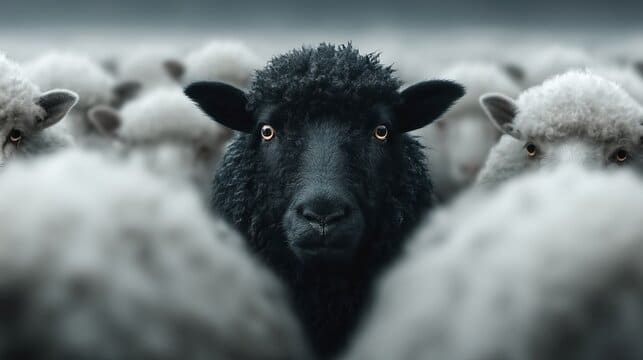
Are you a “black sheep”? I was definitely a “black sheep” in my family and in other areas of my life as I grew into adulthood, going against the grain, non-conformist, the odd one out with beliefs that were often very different from the rest of my relatives and peers. The idiom is interesting as it comes literally from flocks of sheep. When a rare black lamb was form shepherds considered them a liability because their dark wool was less valuable commercially as it could not be dyed.
I used to feel uncomfortable with the moniker, but now I embrace it. Looking back over my life and my work, and can see places where that unique vision led this strong-willed woman to make some excellent decisions and evoke positive changes. That strong will also often got me into a peck of trouble! However, I have become a “woman of a certain age” and it is a time of taking stock. Looking at my life through an evaluative lens. Through that lens, I see that my life is blessed, and I have accomplished some extraordinary things along with colossal mistakes and missteps. Overall, life is good.
I found some other women who were considered “black sheep” very interesting, and I hope you find them interesting too.
“When it comes to justice, there is no easy way to get it. You can’t sugarcoat it. You have to take a stand and say, ‘this is not right.’”Claudette Colvin.
At age 15, Claudette Colvin refused to give up her seat for a white person on a public bus in Montgomery, Alabama – nine months before Rosa Parks did the same. She was arrested and went on to challenge the law in court as a plaintiff in Browder v. Gayle, which ultimately found bus segregation in Montgomery to be unconstitutional.
“I may be the first woman in Congress, but I won’t be the last.” Jeannette Rankin
In 1916, Jeannette Rankin became the first woman elected to Congress. The Montana Republican and fierce women’s rights advocate was one of 50 representatives who voted against declaring war on Germany and entering World War I. Her vote is believed to have ruined her chances for reelection in 1918. She may not have been a “black sheep” in her family, but her lifelong dedication to pacifism, continuously standing alone against the grain, gained her that status among her pro-war contemporaries.
“I don’t want to be just a pretty fish.” Annette Kellerman
Annette Kellerman wasn’t just a “black sheep”—she was a full-blown trailblazer who shattered societal norms! She was a record-breaking Australian swimmer who advocated for women to wear a one-piece bathing suit instead of dresses with stockings — and she was arrested for it. She wore a bathing suit that left her arms bare and cut off at her mid-thigh in 1907, a look that got her arrested in Massachusetts for indecency. The popularity of her swimsuit at the time led her to launch her own swimwear line.
“I remember thinking, ‘Oh my God, it worked!.’” Margaret Hamilton
Neil Armstrong, Buzz Aldrin, and Michael Collins may have walked on the moon in 1969, but Margaret Hamilton helped get them there. She led the Software Engineering Division of the MIT Instrumentation Laboratory, which developed the Apollo spacecraft’s guidance and navigation system. She was a trailblazer who thought and operated differently than the established experts of her era. Her work was vital to the mission’s success.
“I believe everything can change through education. The look on a girl’s face when you give her any information is priceless.” Haifa al-Habibi
In 2016, five years after women in Saudi Arabia were given the right to vote, Haifa al-Habibi became the country’s first female political candidate. While the vast majority of Saudi women wore traditional, head-to-toe black abayas in public, she was noted for campaigning with her face uncovered and regularly wearing bright, colorful clothing. With a stance on education, the architect, newspaper columnist and professor campaigned tirelessly for women and girls, with her face uncovered.
“I never found my sex a hinderment; never faced a difficulty which a woman, as well as a man, could not surmount.” Harriet Chalmers Adams
Harriet Chalmers Adams was a world traveler, photographer, and writer who traveled across the Andes on horseback four times and retraced Christopher Columbus’ path across the West Indies. During the First World War, she served as a correspondent for Harper’s Magazine in Europe and was the only female journalist allowed to visit the trenches. While not a “black sheep” in her family, she went against the grain in her male-dominated profession. She wrote for National Geographic for 50 years, their most prolific female contributor, while also writing for other publications. In 1913, Adams was admitted to the Royal Geographical Society in Britain. But because she was a woman, she was not allowed to join the Explorer’s Club in America. That exclusion may well have been the spark for her to help launch the Society of Woman Geographers in 1925. Adams served as its president for 6 years.
In closing, being the black sheep can give us a powerful advantage. it frees us from the pressure of conformity granting us the freedom to build and live an authentic life on our own terms. Psychologists say that the very traits that make us “black sheep” may often be our hidden strengths.