
My thoughts focus on gratitude as the new year dawns. How does one truly express deep and abiding gratitude?
According to the Merriam-Webster Dictionary, it is the quality of being thankful; readiness to show appreciation. Another source says: thankful and grateful are synonymous with the exception of two operative words. It defines thankful as “conscious of benefits received” while defining grateful as “appreciative of benefits received.” I think the difference between “conscious” and “appreciative” signifies that we experience thankfulness and gratitude for others in two different ways.
Thank you are such simple words. They are seldom adequate. Too often, saying “thank you” is merely polite behavior. Too often, “thanks” is just an automatic reply. Oh, to the store clerk a smile and thank you…that works; to the person who holds the door for you, that works too. But how do you say thank you to the sister (by choice not blood) who is always there for you? To the one who drops everything and drives you to the hospital when the local physician threatens an ambulance. How do you say thank you to the same woman who sits by your bedside for hours, without food or water, and keeps you from spiraling when they tell you that you have to stay? How can you express your gratitude to that woman who drives for hours so you can have a heart procedure, stays with you until you are anesthetized, links her little finger through mine, and allays the fear that threatened to engulf me? She offers herself wholeheartedly with no expectations or strings attached. We have declared that we are now truly “sisters.”
She and her partner gifted me with this new website. They spent many hours saving eight years of content from the old site to avoid losing it during the formation of the new one. I call them Wonder Woman and Superman! They truly are. How can I thank them for their place in my heart, where they are always accepting and loving without judgment? They are the real thing. True gratitude expresses “thank you” not solely from our mouths but also from our hearts. This is from my heart.
There are others that come to mind, my tribe, my soul sisters. They are always available to provide fun, a laugh, and a hand when needed. There is another special soulmate who always has my back and I feel her love and enjoy her cats, Dougie and Quinn, over the many miles. My beautiful, graceful poet friend who lives by the sea with her dog, Tucker. My mentor, who sat with me for hours as I thrashed and sniveled during my last divorce. It was a heartbreaker! She was a saint. My best friend from high school is still very much in my life. She has put up with me for all these years! I remember during the blizzard of 1998 she packed up her three small children and drove from another state to make sure we were all right. We didn’t power or phone service for over fourteen days. She is the one who, after all these years, says, “Love ya!” My adult son who said yeah mom, I’ll come out to Colorado for a week or so to help you move around and get your compression socks on after back surgery. (Fortunately I did not have the surgery, but that does not lessen my gratitude to him for being willing to take a week or so out of his life, his work, come out and help). Another son who shipped a beautiful new bed to me for my comfort. There are so many loving, kind, and generous souls in my life! How does one say thank you for these gifts?
Perhaps I’ll never know how to show them how much they mean, or properly say thank you… but they are in my heart, and my heart knows. I hope theirs do too. My heart is full of gratitude for each and every one of you.
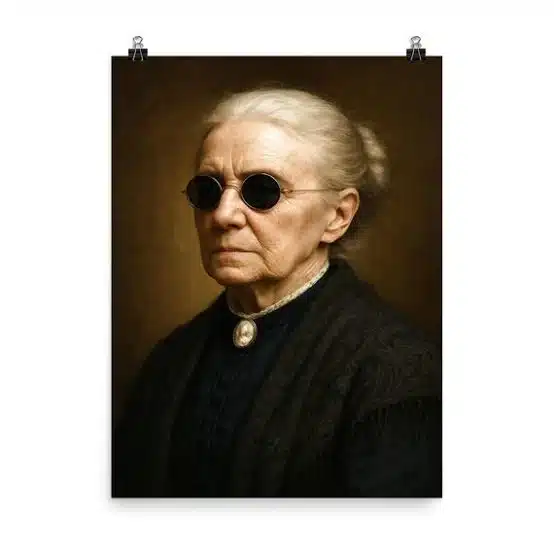
I recently learned of this woman, although I have seen her name in hymnals, and was very inspired. She expressed gratitude meaningfully.
Frances Jane Crosby (“Fanny”) was born on March 24th, 1820, in the little village of Brewster, about fifty miles north of New York City. She was an only child, and her family raised her as a Puritan. She was proud of her faith and traced her ancestors back to Anna Brigham and Simon Crosby, who arrived in Boston in 1635 and were month the founders of Harvard College.
When Frances was only six weeks old, she caught a cold, and it developed into inflammation in her eyes. The family doctor prescribed mustard poultices to treat the discharge. Frances always felt that it was this procedure that damaged her optic nerve and caused her to lose her sight. More modern physicians think that her lack of sight was most likely congenital, and given that she was so young, her parents may not have noticed it.
When Frances was six months old, her father died, and her mother and maternal grandmother raised her. When Frances was three, a renowned surgeon, Valentine Mott, examined her, and after extensive testing, concluded that her blindness was permanent. Her mother and grandmother, who helped her memorize long passages from the Bible tutored her in Christian principles.
At age eight, Frances wrote her first poem. It described her blindness. Years later she said: “It seemed intended by the blessed providence of God that I should be blind all my life, and I thank him for the dispensation. If perfect earthly sight were offered me tomorrow I would not accept it. I might not have sung hymns to the praise of God if I had been distracted by the beautiful and interesting things about me.” According to her biographer Annie Willis, “had it not been for her affliction she might not have so good an education or have so great an influence, and certainly not so fine a memory.” Despite this early tragedy, Fanny grew to be a grateful, active, and happy individual.
By the age of fifteen, Fanny moved to Ridgefield, Connecticut, with her mother, to a home that was sustained by “an abiding Christian faith.” Her early schooling in faith began when she was tiny, and by the age of fifteen she had memorized the four Gospels, the Pentateuch, the Book of Proverbs, the Song of Solomon, and many of the Psalms. In 1832, a music teacher arrived in town twice a week and gave singing lessons to her and some of the other children.
Just before her fifteenth birthday in 1935, Fanny enrolled at the New York Institution for the Blind (NYIB). She studied here for eight years and spent another two years as a graduate student. She learned to play the piano and organ, the harp, guitar, and excelled with her voice as a soprano.
In 1943, Fanny graduated from NYIB and became a lobbyist in Washington, D.C., working for the education of the blind. She was the first woman to speak in the United States Senate, where she read a poem. She appeared before the joint houses of Congress and recited this:
“O ye, who here from every state convene, Illustrious band! may we not hope the scene You now behold will prove to every mind Instruction hath a ray to cheer the blind.”
The following year she joined some other graduates from the NYIP and gave a concert for Congress. She recited an original composition calling for an institution for educating the blind in every state. John Quincy Adams and others offered support and high praise for this endeavor. She continued her campaign for education for the blind for many years.
Fanny joined the NYIB faculty in 1846 as an instructor, teaching grammar, rhetoric, and history. She taught here until three days before her marriage to Alexander van Alstyne on March 5th, 1858. Alexander was a blind music instructor at the New York School for the Blind, where they met. They made their home in a small rural village of Maspeth, New York, population 200. Fanny continued to use her maiden name for all her literary works at her husband’s insistence.