
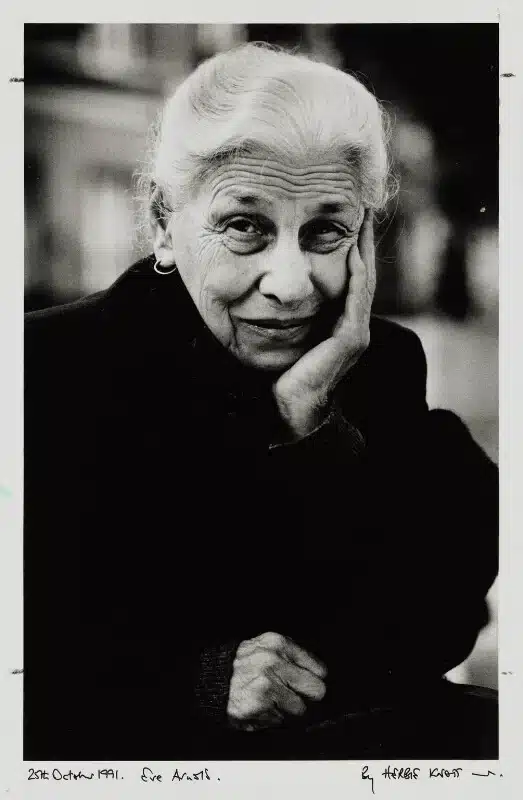
Passion and authenticity are up for me this week. Thinking a lot about them. Often, living with both can be difficult. Societies, families, and others usually express disapproval. As I’ve gotten older, I value both more than ever. When a woman is unleashed and lives by her own light, she is free. That woman sets firm boundaries, lives purposefully, speaks her truth and views mistakes as growth opportunities rather than weakness.
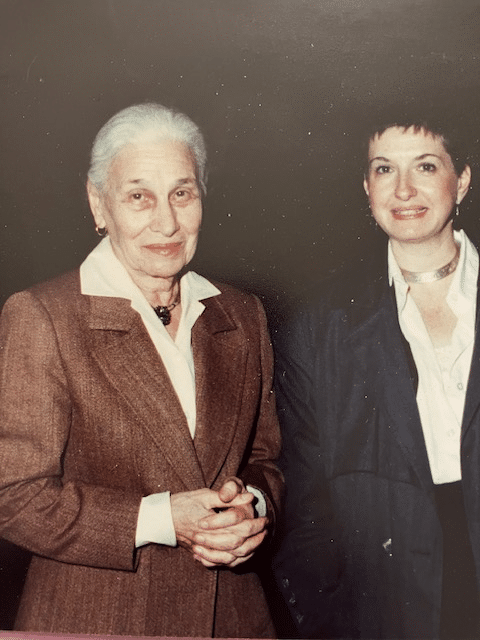
In 1991, I had the privilege of doing a seminar with and spending time with Eve Arnold when we were both at the Rhode Island School of Design. I have always admired her, and over time as I have learned more about her, that admiration has only grown.
Eve Cohen was born on April 21, 1912. She was the fifth of nine children born to immigrant Russian-Orthodox Jewish parents. Her father, William, was a rabbi who, together with his wife, Bessie, immigrated to the United States. Eve didn’t have extensive schooling as a child. Despite this, her parents envisioned a career in medicine for her. This career path did not excite Eve. She did study medicine and explored other career options.
In 1941 (some sources say 1948) Eve married Arnold Schmitz (he later changed his name to Arnold) and their son, Frank, sometimes called Francis, was born in 1948. Arnold was an industrial designer and was very supportive of Eve’s burgeoning career. He gifted her with her first camera, a Rolleicord. She developed a serious interest in photography and began taking photographs of the city from a humanitarian perspective. Her work was in the U.S. Arnold helped to get her prints attention in London. Arnold traveled to England with her, but their marriage faltered and eventually ended.
Eve continued on her own and became iconic. The birth of her son, Frank, marked the beginning of Eve’s photographic journey, and the domestic scenes she captured, including him, became the foundation of her groundbreaking career. Sadly, her family of origin “eventually accepted what I did, but grudgingly.” When Eve did a Life magazine story on the first five minutes of a baby’s life, her mother’s reaction- “What’s to be proud of?” Her father was likewise unimpressed, as this was not the career he had chosen for his daughter. In addition, it was an Orthodox Jewish tradition that forbade creating “graven images,” making her chosen career path unconventional and unacceptable.
Eve’s serious interest in photography began in 1946, when she was thirty-four, while working for Kodak at their Fair Lawn, New Jersey, photo finishing plant.Two years later she attended a six-week course at the New School for Social Research in Manhattan, which changed her life. This pivotal moment in her life came from this short, intensive course in photography, taught by Alexey Brodovitch. (Alexey Vyacheslavovich Brodovitch was a Russian-American photographer of Belarussian descent, designer and instructor who is most famous for his art direction of fashion magazine Harper’s Bazaar.)
Inspired by this intensive, Eve created a collection of photos from Harlem’s vivid fashion show series. Her work appeared in other major American news magazines now, including Time and Life. This series in Picture Post launched her career as a photographer. Sadly, she noted that the editor of that magazine reversed the message that she had assigned the photos to fit a racist narrative.
Perhaps because of this racial narrative twist, Eve became interested in African American workers suffering housing discrimination on Long Island. She documents the harsh realities and unfair housing issues facing these migrant workers, those working in agricultural fields, especially the pea pickers during the late 1950s. She used her compassion to reveal their struggles and advocate for them. Her images were powerful, and she used her art to bring about social change. She captured the lives of the disadvantaged, moving beyond her initial fashion work in Harlem. Eve used her camera as a tool to expose the human cost of inequality in housing and the unfairness of labor on Long Island. Her classmates mocked her early photos because they considered them “bad” and unconventional for the time, likely because of their raw, unglamorous reality and perhaps her outsider status as a woman in photography, but this rejection fueled her determination. “If a photographer cares about the people before the lens and is compassionate, much is given. It is the photographer, not the camera, that is the instrument.”
In 1951, the Magnum group headhunted Eve. The Magnum Photos agency was probably the most important artists’ cooperative ever created. In 1947, four pioneering photographers founded this now-legendary alliance. Together, they brought an extraordinary range of legendary styles together in one powerful collaboration. Henri Cartier-Bresson, Robert Capa, George Rodger and David Seymore began Magnum over a bottle of champagne. Capa and Seymore were war photographers. Magnum’s photographers share a vision to chronicle world events, people, places, and culture, accompanied by a compelling narrative that defies convention, shatters the status quo, redefines history, and transforms lives.
Eve prepared a portfolio of her work that same year for the co-founder, Robert Capa. The work she used was the Harlem fashion photos and the migrant agriculture workers in Long Island. These were some of her first. He recognized both quality and a unique perspective, which impressed him. The unique perspective was the very quality her classmates had mocked her for. He accepted her on the spot as an associate member. She became a full member in 1957 and was the first woman to do so.
Magnum was male-dominated and a pretty “macho culture” back in the fifties. This didn’t faze Eve one bit. She had not only steely determination to succeed but an amazing work ethic. Her colleague, Elliott Erwitt, said that her “steel and integrity’ lay beneath a tiny, unaggressive exterior. When approaching subjects, she always used a curious and compassionate approach. This enabled her not only to build trust but also to produce authentic and moving images that revealed the heart and soul of her subjects. Maybe because of this she always seemed to secure high profile assignments. Her very first job for Magnum was shooting Marlene Dietrich. She also had a long term intimate work with Marilyn Monroe. This work helped guarantee her prestige at this agency. She became a world-renowned photojournalist known for her authenticity in capturing the human experience. “I have been poor, and I wanted to document poverty; I had lost a child and was obsessed with birth; I was interested in politics and I wanted to know how it affected our lives; I am a woman and I wanted to know about women.”
As Eve’s portfolio and reputation grew, she photographed many well-known celebrities. James Cagney at his home dancing with his wife, Willy, who was a former chorus girl, was a favorite. Cagney sang dirty Yiddish ditties to her. Although he was Catholic, Cagney grew up on the Upper East Side. Eve photographed John Huston and his youngest daughter, Angelica, Margot Fonteyn, Rudolph Nureyev and Queen Elizabeth II, and Yves Montand. She gained rare access to and did a reportage of Malcolm X, following him for over a year to rallies and meetings. Malcolm understood the power of images and collaborated with Eve, which resulted in iconic photos illustrating his depth and purpose. Christina, her daughter, later dressed Joan Crawford for a photo (who would later expose her mother in “Mommie Dearest). Once, Eve remembers Crawford was utterly drunk and posed nude. Her career in blue films was just beginning.” She was a sad, benighted creature,” Arnold says. “I never printed the pictures, but I sent her the negatives and that made me her friend for life.”
Eve covered the civil rights and black power movements in the United States, often returning home with cigarette burns in her clothing, compliments of a disapproving crowd. She didn’t shoot only in the U.S. She traveled the world to get photos; Russia, India, China, South Africa and Afghanistan and throughout the United States. She was the first American photographer allowed into China. It took fifteen years, but she finally had a permit to travel over the entire immense territory pretty much without restrictions. She could document only ordinary life. She captured the spirit of the people uniquely. During the three-month journey, her vibrant color photos showed a country in transition from places like Xinjiang, Inner Mongolia and Tibet, covering 40,000 miles. Several of her famous photographs appeared in Look, Life, Esquire, Harper’s Bazar, Geo, Paris-Match, and Epoca.
In 1954, Eve covered the Republican Party press events and the McCarthy hearings. Senator Joseph McCarthy’s tactics were under investigation after he accused the U.S. Army of harboring communists. His broader anti-communist crusade began early in 1954, and these hearings exposed just how paranoid these claims were. Later that year, they censured him, but the Red Scare had done its worst. Outspoken individuals, particularly those holding progressive or leftist views, faced severe repercussions. This might sound familiar now in 2026? They were blacklisted, lost jobs, and had careers and families ruined. Committees like HUAC (House Un-American Activities Committee) investigated them. Many suffered public shaming, and sometimes even faced legal prosecution or imprisonment. It was guilt by association and often based on nothing but the flimsiest of evidence. Law enforcement harassed people, and they became alienated from society, fostering intense fear and silencing dissent. This sounds very familiar. Some of the more famous people blacklisted during this era are: Charlie Chaplin, Pete Seeger, Lena Horne, Burgess Meredith, Burl Ives, Judy Holliday, John Garfield, Orson Welles, Langston Hughes, Arthur Miller, Dashiell Hammett, Dorothy Parker, and Leonard Bernstein to name just a few of the more well knowns.
Eve’s photographs really revealed the raw human drama and extreme harshness of the anti-communist witch hunts. They speak volumes, humanizing the era’s figures. Amazing candid shots illustrated McCarthy’s manipulative persona and what she called “oily charm.” Those photos became a powerful visual record of this pivotal moment in American history. Major magazines published Eve’s work, which exposed the political spectacle to the general public. She always focused on the marginalized, and during the hearings, she captured the experiences of those targeted by McCarthy’s accusations. This contributed to growing public awareness and, probably eventually, the downfall of Joseph McCarthy. It was visual storytelling. Eve let her camera tell the story of the hearings, making the abstract fear of McCarthyism tangible for all to view.
Later, when the Guardian asked Eve what that experience was like for her, she only shuddered and uttered the word, “Terrible.” Eve said that she experienced the same paralyzing fear that so many Americans had at the hands of Joseph McCarthy. “I was the only woman in the press corps,” she says. “So when we broke for lunch, McCarthy came over and put his arm around my shoulder. I put my hand up to remove his hand because I could not bear the thought of being touched by him, but with my hand up there I realized I couldn’t do that. I found out you didn’t play games with that man. If he put his hand on you, you didn’t want to have your past checked out – although I had nothing to hide. So I wound up holding hands with McCarthy, dying inside…The other press men looked at me in horror, with the great man’s hand on my shoulder. I said: ‘Excuse me, Senator, I got to go to work,’ and moved away from him and photographed him and Roy Cohn, who had just been around all the American libraries in Europe throwing out books. When I went down for lunch in the Senate dining room, before I could even order my soup, the journalists, about 30 of them, all turned away; nobody would talk to me. So awful was the sense of horror in that room. I could not tell these men why I had done that.” Of course, she felt paralyzed by fear and realized she could not publicly rebuke him without risking an investigation into her own background.
Eve moved to England with Frank in 1962, and they sent him to Beadales for education. (Bedales School is a coeducational boarding and day public school in the village of Steep, near the market town of Petersfield in Hampshire, England). She often photographed him, and in the early days, there were many photos of him playing with Marilyn Monroe. His son, Michael Arnold, is the archivist for Eve’s work. Eve lived in England from that point forward, with brief intervals working elsewhere.
In 1965, Eve applied for and received a Russian visa. This resulted in a fun story about the oldest man in the world. She enjoyed it, and apparently the Russians liked it too because the following year she applied again for another visa. They granted it. Eve always wanted to dive deeper. She knew that the Russian dissidents were being tortured and held in psychiatric wards, and she wanted to document it. Eve knew they would deny her if she asked to visit them and take photographs. But photograph she did! How, you may ask? She didn’t ask to see the dissidents, but demurely asked to see a psychiatrist, posing as a journalist interested in general psychiatry. This worked, and she gained entrance. An efficacious official led Eve on a tour, and then the official took a phone call for a few minutes. She works on what she calls “robber’s time,” swiftly and covertly grabbing shots, often without the subject even realizing it. It was a cunning strategy that she developed well. So while the official was taking a phone call, she took quick shots through a window. The images she captured were powerful; dissidents undergoing harsh hydrotherapy, being submerged in baths with rubber tires. Other political prisoners were being treated as mentally ill. The images she snapped exposed the Soviet Union’s practice of holding political dissidents in psychiatric wards, highlighting the human rights abuses, Soviet oppression and social injustice. A picture is worth a thousand words.
Eve Arnold remained passionate about her art and her work throughout her life. The fire was never extinguished. She often conversed about the specific details of her art: light, color film, and cameras. She favored Nikon cameras. Manual vs automatics – she said, “automatics were “Infradig” (yes, I had to look it up too…beneath one; demeaning) one does not even bother to acknowledge the digital.” Clearly, the manual Nikon was her camera of choice. Eve recalls that someone stole all of her precious Nikons in India. Arriving back in New York, she decided that since she had to replace them, start over, she would go “high-Class and get a load of Leicas. She ordered them, had them packaged up and as she reached the door of the shop, she turned back and said, “I don’t want any of these. I had very good luck with Nikons, so I’ll stick to them.”
Despite the diversity of her subject matter, a theme that ran through all of her work was an ability to capture spontaneous moments often just in natural light. She loved taking photos of everyday life, observing people wherever they were, capturing that moment. “I looked for a sense of reality in everything I did. I didn’t work in a studio, I didn’t light anything.” That was the unique beauty of her work.
Eve Arnold had her first major solo exhibition at the Brooklyn Museum, showcasing her China images. She received both the National Book Award and a Lifetime Achievement Award that year. Later on, she received many other awards and honors. In 1995, the Royal Photographic Society made her a fellow, and New York’s International Center of Photography elected her Master Photographer, the world’s most prestigious photographic honor. In 1996, she received the Kraszna-Krausz Book Award for In Retrospect, and the following year the University of St Andrews, Staffordshire University, and the American International University in London granted her honorary degrees. The museum also appointed her to its advisory committee in Bradford, UK.
Thought her career, Eve’s goal was always to “show you something you would not have otherwise seen.”